
The Importance of Regular Gutter Cleaning for Protecting Your Landscape and Foundation
When gutters clog, rainwater stops following the path your house was built for. Instead of moving through the gutter and out the downspout, it spills over the edge and drops beside your home.
That causes two problems fast: washed-out landscaping and water pressure around the foundation. Regular gutter cleaning is one of the lowest-cost ways to avoid much larger repair bills later, and if the job feels risky or overdue, a professional crew like Chozen Gardens can handle it safely.
How clogged gutters send water straight toward your home
Gutters have one simple job. They catch roof runoff and move it away from the house. When leaves, needles, twigs, and roof grit pile up, that path closes off.
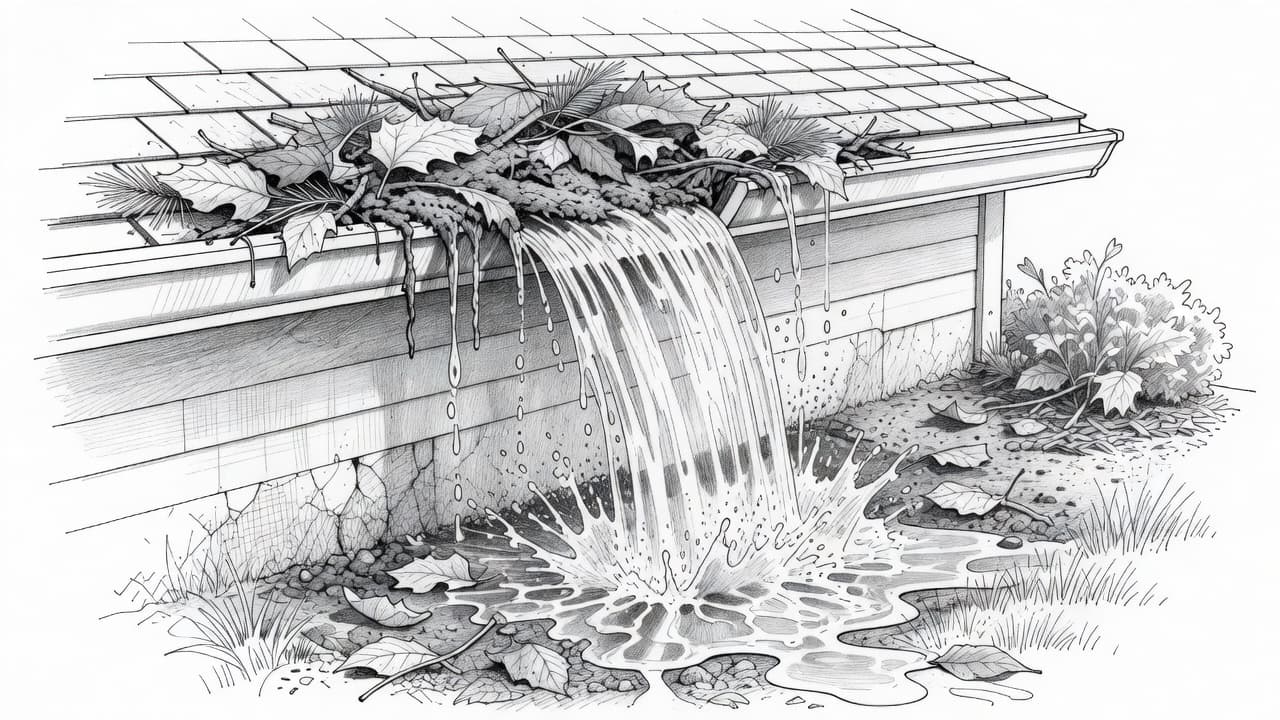 In dry weather, the problem can hide in plain sight. Once Oregon rain starts, the trouble shows up all at once.
What happens when water overflows the gutter line
Overflowing gutters dump water in concentrated sheets instead of controlled channels. That changes the whole drainage pattern around your home.
For scale, KGUARD reports that a 2,000-square-foot roof can shed about 1,250 gallons during a 1-inch rain. If the gutter is blocked, that water may pour out at only a few weak spots. As a result, the same patches of soil get hammered again and again.
In Hillsboro, Beaverton, and Aloha, repeated winter storms can turn that overflow into puddles beside the house. Then mulch floats away, soil erodes, and the ground stays wet longer than it should.
Water that misses the downspout usually lands in the worst possible place, right next to your home.
Why downspouts matter just as much as the gutters themselves
A clean gutter still fails if the downspouts are clogged, crushed, or too short. Water has to leave the roofline and travel far enough from the house to matter.
A good target is at least 4 feet away from the foundation. If a downspout empties right at the base of the wall, you're still feeding water into the same danger zone. In other words, clean troughs alone don't solve the problem.
That's why a full gutter service should include checking every elbow, outlet, and extension. Chozen Gardens can also spot drainage issues beyond the gutter itself, including runoff patterns that may call for added extensions or a French drain.
Protecting your foundation from erosion, cracks, and standing water
Water near the foundation is a slow-burn problem. You may not see damage after one storm, but you can see the effects after a season of overflow.
How pooled water weakens soil around the foundation
When soil gets saturated, it loses stability. Some of it washes away, while the rest can swell and shift. Over time, that movement leaves parts of the foundation with less support.
Then cracks can form in concrete, crawl space walls, or slabs. Water can also push against foundation walls as wet soil builds pressure around them. That pressure, often called hydrostatic pressure, can lead to leaks, bowing, and settling.
The danger isn't only underground. Erie Insurance notes that water weighs about 8 pounds per gallon. So a gutter packed with water and debris can sag, pull loose, or separate at the seams, which sends even more runoff toward the house.
The hidden costs of waiting too long to fix drainage problems
Routine cleaning is maintenance. Foundation repair is a construction project.
Once drainage problems start affecting the base of the home, costs rise fast. You may face crack repair, moisture cleanup, mold issues in a crawl space, or damaged walkways near the house. Because those problems build gradually, many homeowners wait until the signs are hard to ignore.
A professional inspection can catch trouble earlier. Sagging sections, bad gutter pitch, loose fasteners, and short downspouts are all easier to fix before water starts changing the ground around your home.
Keeping your landscaping healthy instead of washed away
Most homeowners notice yard damage before they notice structural damage. That's because overflowing gutters hit flower beds, lawn edges, patios, and shrubs first.
How overflowing gutters strip mulch and topsoil from garden beds
A strong stream of runoff can flatten a neat bed in one storm. First the mulch shifts. Then topsoil washes out. After that, plant roots start to show.
Repeated overflow carves the same path every time it rains. So the damage gets deeper, not wider. Meanwhile, the rest of the bed may stay muddy for days, which stresses shrubs and perennials that need good drainage.
The same runoff can also undermine hardscape edges. If water keeps washing below pavers or walkways, those surfaces may settle or crack.
Why controlled drainage helps plants thrive after heavy rain
Plants need water, but they don't need a roof-sized waterfall dumped on them. Clean gutters spread drainage back into the system your house was designed to use.
That means less soil loss, fewer splashed-up weeds, and cleaner beds after storms. Roots stay covered, mulch stays in place, and the yard holds its shape longer. If you've spent time and money on curb appeal, this matters.
Chozen Gardens works on more than gutters. Because the company also handles drainage and landscaping, it can look at the whole picture when runoff keeps damaging the same part of your yard.
How often you should clean gutters in a wet climate like Oregon
In the Pacific Northwest, twice a year is the minimum for most homes. A spring cleaning clears winter buildup, and a fall cleaning deals with leaves before heavy rain sets in.
Homes near firs, pines, or large maples often need more attention. Roof valleys, shaded corners, and gutters near overhanging branches can clog much faster. It also helps to check gutters after windstorms, because one rough weekend can fill them with debris.
Signs your gutters need attention right away
If you see any of these, don't wait for the next storm:
- Water spilling over the edge during rain
- Sagging or separated gutter sections
- Plants or moss growing in the gutter trough
- Stains on siding or dirt splash near the base of the house
- Puddles forming beside the foundation
These signs usually mean the system is already failing, not that it might fail later.
When a professional cleaning is the safer choice
Ladders, wet roofs, and compacted debris are a bad mix. The risk goes up on two-story homes, steep rooflines, and houses with heavy tree cover.
That's where Chozen Gardens makes sense. The company is licensed, bonded, and insured, and it serves homeowners across Hillsboro, Beaverton, Aloha, Washington County, and nearby Portland-area communities. If your gutters are overflowing, packed with debris, or draining too close to the house, call for a quote before a small problem turns expensive.
Final Thoughts
Clean gutters protect more than the roof edge. They protect your yard, your drainage pattern, and the soil holding up your home.
If you live in Hillsboro, Beaverton, Aloha, or elsewhere in Washington County, Chozen Gardens can help with gutter cleaning, drainage support, and runoff issues around the foundation. A simple service now can save your landscaping, your concrete, and a lot of stress later.