
Why Is Water Pooling in My Yard? Common Drainage Problems and Solutions
Standing water after rain can damage grass, plants, foundations, crawl spaces, retaining walls, and surrounding soil. If you're dealing with water pooling in my yard, the cause is usually simple: your property can't move or absorb runoff fast enough.
The puddle may appear in one place while the source sits uphill, on the roof, or beside the house. Start with a few safe observations, then bring in Chozen Gardens when the problem needs a lasting Portland-area drainage solution.
Why Is Water Pooling in My Yard? Common Drainage Problems and Solutions
Most drainage issues come down to low ground, compacted soil, blocked runoff paths, or too much water arriving in one area at once. Clay-heavy Portland soils can make the problem worse because water drains slowly through them.
A visible puddle isn't always the true source. Water may travel beneath mulch, turf, hardscaping, or loose soil before it settles in the lowest point. Portland code generally requires building pads to drain at a 2% slope toward approved drainage facilities. A 1% slope is allowed only under limited conditions, so that standard doesn't apply to every residential yard.
Low spots, compacted soil, and grading that sends water toward the house
Settled soil, construction traffic, landscape changes, and natural dips can create a bowl-shaped area in the lawn. During a hard rain, that area fills faster than the soil can absorb water.
Ground near the house should generally slope away from the foundation. However, regrading near a retaining wall, septic area, or steep slope needs careful planning. Watch for saturated soil, muddy grass, foundation cracks, erosion channels, or water entering a crawl space. These signs often point to a larger drainage problem than a simple lawn puddle.
Downspouts and runoff that overwhelm the yard
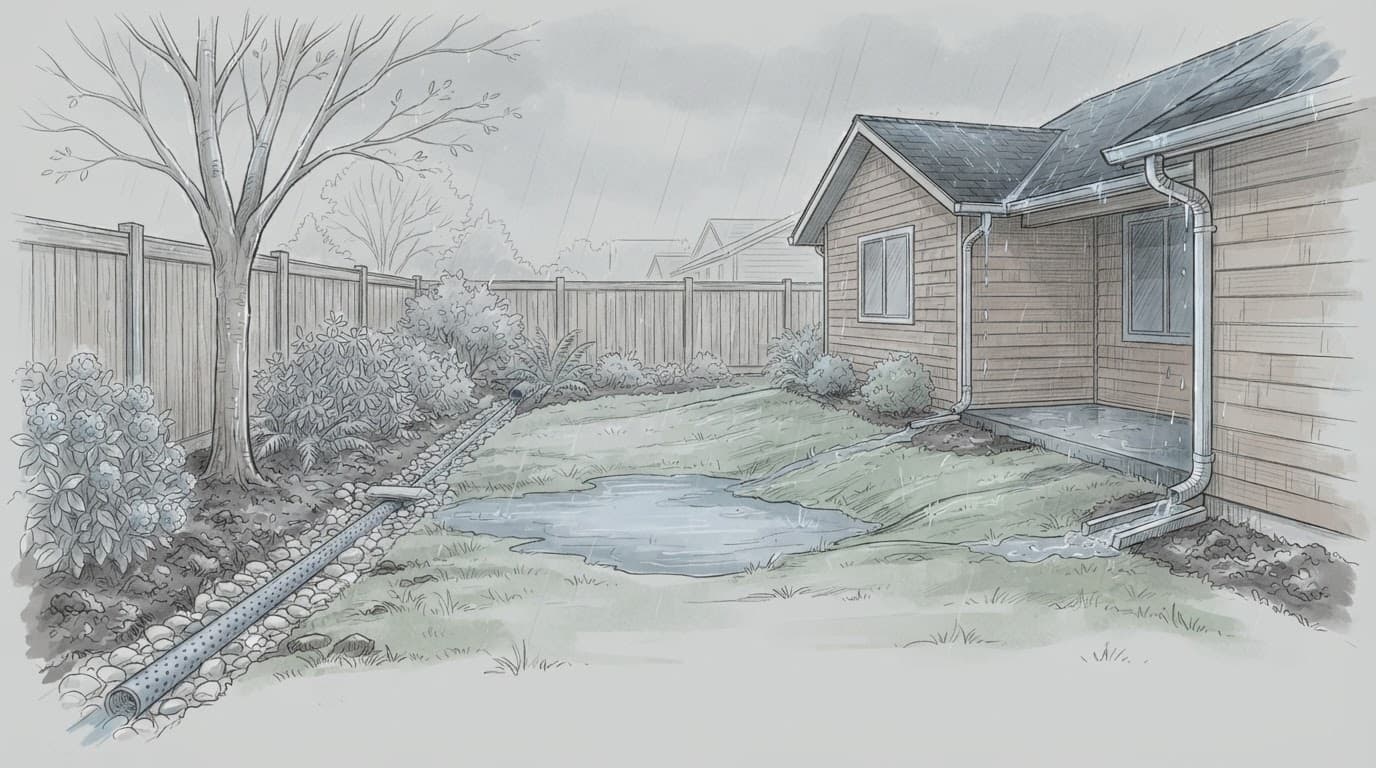
One roof can send a surprising amount of water into a small patch of ground. A short downspout outlet beside the foundation can soak soil, wash away mulch, and create recurring pools.
Oregon State Sea Grant recommends extending downspouts at least 6 feet from a basement structure or 2 feet from a crawl-space or slab foundation. Keep the outlet at least 5 feet from a neighboring property and 3 feet from a public sidewalk. A splash block or gravel pad also helps prevent erosion.
Don't send roof runoff toward a neighbor, retaining wall, septic drain field, or underground storage tank.
How to Fix Yard Drainage Problems Without Creating New Damage
Before choosing a fix, observe the yard during rain and again several hours later. That shows whether the issue is surface runoff, poor soil infiltration, groundwater, or an outlet that sends water somewhere unsafe.
Start with downspout extensions, surface grading, and safe water flow
First, clear gutters and downspouts. Then check where each outlet discharges. Extending a downspout or adding a splash block may solve a small water pooling in my yard problem without excavation.
Minor low spots can often be filled with suitable soil and restored with grass or groundcover. Mulch, gravel, and established plants can slow water and protect bare soil. Still, don't merely move runoff into another depression.
Portland guidance focuses on keeping runoff and sediment out of storm drains, public rights-of-way, and nearby water bodies. Direct surface water toward an approved drainage area that can handle it safely.
Use French drains, swales, or catch basins for persistent runoff
A French drain uses perforated pipe and drainage stone below ground to intercept water and move it to a safe outlet. It works well when runoff repeatedly crosses the same area or saturates soil near a structure.
A shallow swale moves water across the surface, while a catch basin collects water at a low point before sending it through solid pipe. Each option needs proper slope, filtration, cleanouts, and a legal discharge location.
A drain without a safe outlet can shift the problem downhill, where it may damage soil, structures, or a neighboring property.
Trenching near utilities, foundations, retaining walls, or property lines calls for a qualified professional.
Consider a rain garden when the soil and location are suitable
A rain garden holds runoff temporarily, filters it through soil, and supports moisture-tolerant plants. Oregon State Sea Grant recommends a depth of roughly 6 to 24 inches and soil that drains at least one-half inch per hour.
Rain gardens need distance from foundations and a planned downspout disconnection. They aren't a good fit for sites with a high water table, very slow drainage, or unsafe slopes.
When to Call Chozen Gardens for a Professional Drainage Plan
Basic maintenance can solve minor runoff. However, recurring standing water near your home, fence, trees, or retaining walls needs a property-wide assessment.
Chozen Gardens is a licensed, bonded, and insured Oregon property-services company serving Washington County and the greater Portland area. The team can evaluate grading, soil conditions, trees, hardscaping, runoff paths, and existing structures before recommending drainage work.
Get help when water threatens your foundation, slope, or property
Call for an on-site assessment when you notice:
- Water entering a basement or crawl space after rain.
- Pooling that continues after gutter cleaning and downspout extensions.
- Erosion channels deeper than about 2 inches or spreading sediment.
- Saturated ground near a retaining wall or an unstable slope.
- Runoff that crosses property lines or damages planted areas.
Portland slope work can require engineered terraces, subdrainage, or other design details. Those warning signs are useful, but they don't replace a site inspection.
Plan drainage work around Portland permits and local rules
Major grading, trenching, work near public drainage, and ground disturbance may trigger Portland permit or erosion-control requirements. Earthwork over 10 cubic yards can require site-development review, and erosion-control measures must be in place before ground-disturbing work begins.
Drainage must flow to an approved destination. Don't connect to or alter public sewer or stormwater facilities without checking local requirements first.
Chozen Gardens can help plan dependable drainage solutions alongside landscaping, fencing, concrete patios, and outdoor improvements that protect the rest of your yard.
Protect Your Yard Before the Next Heavy Rain
Pooling water usually points to a grading, soil, runoff, or drainage-path problem. It rarely disappears for good without correcting the condition that traps the water.
Start with gutters, downspout outlets, and visible low spots. When water pooling in my yard persists near a structure, slope, or erosion area, contact Chozen Gardens for a local assessment and a long-term drainage plan.